
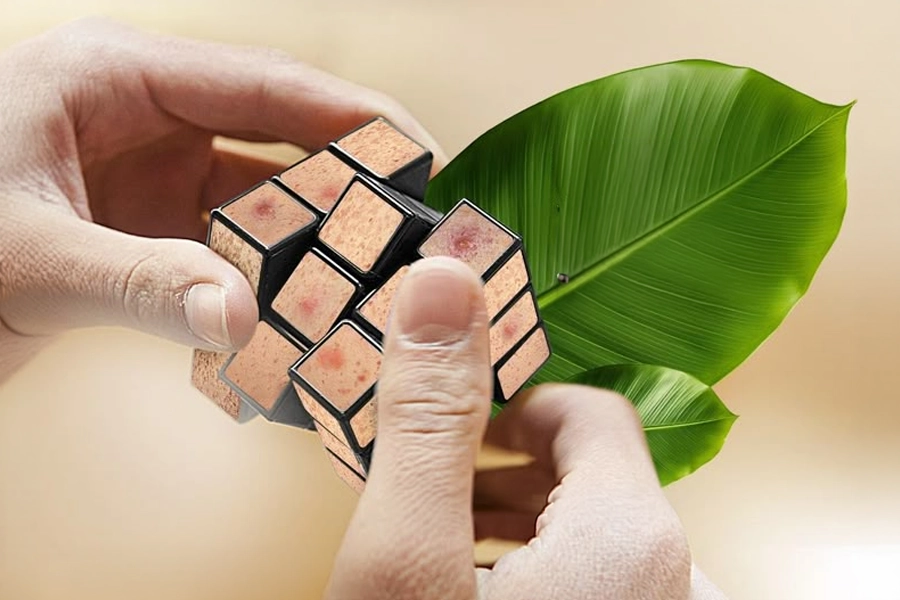
With the foundational concepts of Twak, the doshas, Agni, and Rakta Dhatu covered in earlier posts, it's time to see how they come together in practice — starting with one of the most common skin complaints: acne. In Ayurveda, acne is known as Yauvana Pidika, literally "eruptions of youth," reflecting how closely it's traditionally associated with the hormonal and metabolic changes of adolescence and young adulthood.
What Causes Acne in Ayurveda?
Acne is generally described as a Pitta-Kapha disorder, and understanding why requires connecting several of the concepts from earlier posts:
- Pitta contributes the heat, inflammation, and redness — the "active" component of a breakout. Excess Pitta is thought to increase oil production and create the burning, irritated quality seen in inflamed pimples and cystic lesions.
- Kapha contributes the congestion — the oiliness, clogged pores, and the tendency for lesions to be slow-healing and thick rather than quickly resolving.
- Underlying both is often Tikshna or Manda Agni (from the Agni post) — either overactive digestion generating internal heat, or sluggish digestion allowing Ama to accumulate.
- That accumulated Ama eventually reaches and vitiates Rakta Dhatu (the blood tissue), and this Rakta Dushti is considered the direct trigger for eruptions on the skin.
In short: acne isn't viewed as a surface problem with oil glands, but as the visible endpoint of a chain running from weak digestion, to toxin accumulation, to blood impurity, expressed through Pitta-Kapha imbalance on the skin.
Ayurvedic Approaches to Managing Acne
Because the root is considered systemic, Ayurvedic acne management typically works on several fronts at once rather than relying on a single topical fix.
1. Diet (Pathya-Apathya)
Foods that aggravate Pitta and Kapha — fried, oily, spicy, and excessively sweet or dairy-heavy foods — are generally reduced. Cooling, light, and easily digestible foods are favored instead, along with bitter and astringent tastes, which are considered naturally purifying for the blood.
2. Blood-Purifying Herbs (Raktashodhak)
Herbs like neem, manjistha, and turmeric are commonly used, taken internally or applied topically, specifically for their traditional blood-cleansing and anti-inflammatory properties.
3. Supporting Agni
Since impaired digestion is seen as a root cause, herbs and practices that gently kindle Agni without aggravating Pitta — such as small amounts of ginger or cumin — are often recommended, along with regular meal timing and avoiding overeating.
4. Panchakarma or Detox Protocols
For more persistent or cystic acne, therapies aimed at clearing Ama and purifying the blood — such as Virechana (therapeutic purgation) — may traditionally be used under guidance, on the reasoning that surface treatment alone won't resolve a systemic imbalance.
5. Topical Applications
Pastes and masks using neem, turmeric, sandalwood, or multani mitti (fuller's earth) are commonly applied to calm inflammation and absorb excess oil, functioning as the "local" complement to the internal treatment.
6. Lifestyle Factors
Stress management, adequate sleep, and avoiding excessive heat exposure are also emphasized, since both stress and heat are traditionally linked to Pitta aggravation.
The Bigger Picture
Yauvana Pidika is a useful case study for how Ayurveda approaches skin disease generally: rather than isolating acne as a dermatological event, it's treated as a symptom that points back to digestion, dosha imbalance, and blood quality. This is why a traditional Ayurvedic acne protocol often looks less like a skincare routine and more like a temporary shift in diet, herbs, and daily habits — the visible eruptions are treated as the last step in a longer internal process, not the starting point.