
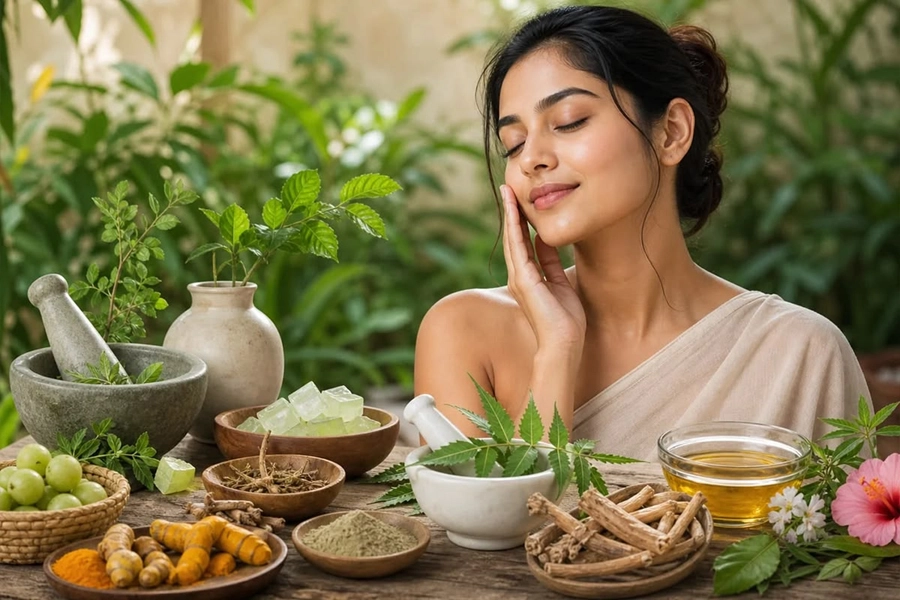
Skin is often the first place the body tells us something is out of balance. Long before modern dermatology mapped out the biology of breakouts and rashes, Ayurveda had already built a detailed framework for understanding skin — how it's structured, what shapes its behavior, and what causes it to break down. This post walks through three foundational Ayurvedic concepts that anchor almost every skin-related discussion in this tradition: the seven layers of skin (Twak Sapta Dhatu), the role of the three doshas, and the concept of Ama, or toxins, as a root cause of chronic skin disease.
1. Twak: The Seven Layers of Skin in Ayurveda
In Ayurveda, the skin is called Twak, and it's regarded as far more than a protective covering — it's considered a mirror of the body's internal health, closely linked to the blood tissue (Rakta Dhatu) and the mind. Classical texts describe the skin as composed of seven distinct layers, collectively known as Twak Sapta Dhatu. Each layer is believed to have its own function and its own vulnerability to specific disorders:
- Avabhasini – the outermost layer, responsible for the skin's natural glow and complexion. Disorders here tend to be superficial, like minor discoloration.
- Lohita – tied to the reddish tone beneath the surface; imbalances can manifest as moles or pigmentation issues.
- Shweta – a paler layer linked to conditions that cause whitish patches or lesions.
- Tamra – copper-toned layer, connected to certain inflammatory skin eruptions.
- Vedini – associated with sensation; disorders here often bring pain or heightened sensitivity, as seen in some forms of eczema.
- Rohini – involved in the skin's regenerative capacity; when this layer is disturbed, healing slows and scarring can result.
- Mamsadhara – the deepest layer, connecting skin to the muscle tissue beneath; deep-seated, stubborn skin conditions are often traced here.
This layered model matters because it gives Ayurvedic practitioners a way to gauge how deep-rooted a skin issue is. A superficial blemish on Avabhasini is treated very differently from a chronic condition believed to originate in Mamsadhara. It also explains why Ayurvedic skin treatments often work gradually — deeper layers are thought to take longer to heal and require more sustained, systemic care rather than surface-level fixes.
2. Vata, Pitta, Kapha: The Doshas Behind Your Skin Type
Ayurveda's most well-known concept — the tridosha theory — plays a central role in understanding both normal skin type and skin disease. Each person is thought to have a unique constitution (Prakriti) shaped by the three doshas, and skin tends to reflect whichever dosha is dominant or currently imbalanced.
Vata skin tends to be dry, thin, and prone to roughness, flaking, and premature fine lines. When Vata is aggravated — often by stress, irregular routines, cold weather, or dehydration — the skin can become excessively dry, cracked, or dull.
Pitta skin is typically warm, sensitive, and prone to redness, inflammation, and breakouts. Pitta imbalance is closely associated with conditions like acne, rosacea, and rashes that come with a burning or inflamed quality — essentially, "hot" skin conditions.
Kapha skin tends to be naturally oily, thick, and cool, with a tendency toward congestion. When Kapha is out of balance, the result is often clogged pores, cystic acne, or a sluggish, congested complexion.
Most people aren't purely one dosha; skin conditions frequently arise from a combination, such as Pitta-Kapha acne (inflamed and congested) or Vata-Pitta sensitivity (dry but reactive). This is why Ayurvedic skincare isn't one-size-fits-all: a treatment that soothes Pitta-driven redness might actually worsen Vata-driven dryness. Identifying which dosha is driving a particular skin issue is considered the essential first step before any remedy — herbal, dietary, or topical — is recommended.
3. Ama: The Hidden Toxin Behind Chronic Skin Disease
Perhaps the most distinctive Ayurvedic idea when it comes to persistent, hard-to-treat skin conditions is Ama — a sticky, toxic byproduct that forms when digestion (governed by Agni, the digestive fire) is weak or impaired. When food isn't fully digested, Ayurveda holds that it doesn't just pass through harmlessly; it turns into Ama, which then circulates through the body's channels (Srotas) and can lodge in tissues, including the skin.
Ama is considered a major underlying factor in chronic, recurring skin disorders — conditions that don't respond well to surface treatment because their root cause lies in digestion rather than the skin itself. This is the basis for the Ayurvedic idea of the gut-skin connection, a concept modern research has also started to take seriously through the study of the gut microbiome and inflammatory skin conditions.
Signs that Ama may be contributing to a skin issue include:
- Skin problems that flare up after eating heavy, oily, or processed foods
- A coated tongue, sluggish digestion, or bloating alongside skin symptoms
- Skin conditions that seem resistant to topical treatment alone
- A general feeling of heaviness or low energy accompanying the flare-up
Because Ama is seen as a systemic issue, addressing it typically involves more than skincare — it calls for improving Agni through diet, routine, and sometimes detoxification practices (like those used in Panchakarma). Treating only the visible skin symptom while ignoring Ama is considered, in this framework, a temporary fix rather than a real solution.
Bringing It Together
These three concepts build on each other in a logical way: Twak gives you the map of where a skin issue lives, the doshas explain the underlying tendency or trigger, and Ama points to whether the root cause is systemic, originating deep in digestion rather than on the surface. Together, they form the diagnostic lens Ayurveda uses before recommending any remedy, which is why traditional treatment so often starts with questions about diet, digestion, and daily habits rather than which cream to apply.
Understanding this framework doesn't just add historical or cultural context, it offers a genuinely different way to think about skin health: not as an isolated organ to be treated topically, but as a reflection of what's happening throughout the whole body.