
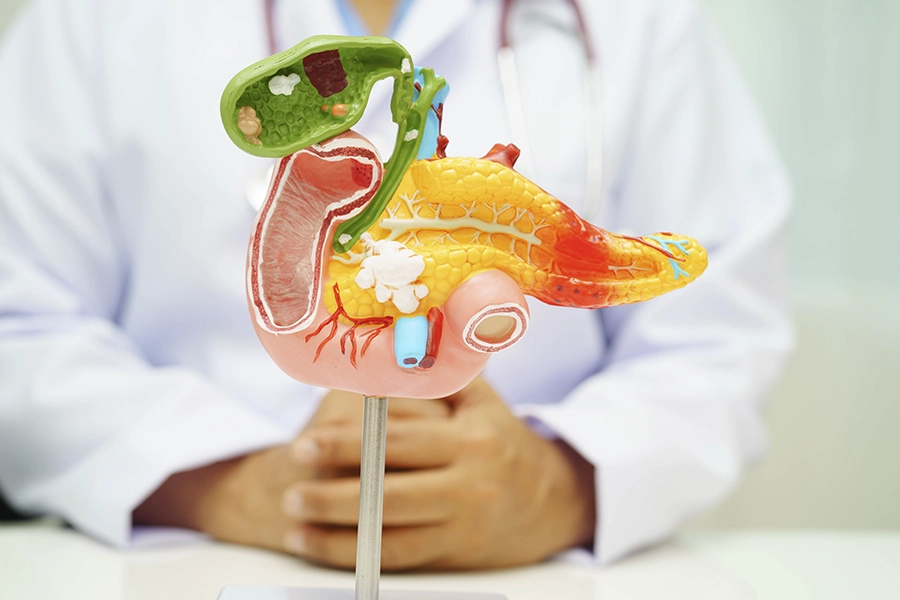
Gallstones are one of the most common digestive complaints worldwide, and many people who have them, or want to avoid them, end up asking the same question: why do they form in the first place? Modern medicine explains this mostly through cholesterol saturation and bile chemistry. Ayurveda, India's traditional medical system, tells a parallel story — one centered on heat, digestion, and balance. Looking at both together gives a fuller picture of what's really going on inside the gallbladder.
The Modern Starting Point
In conventional terms, gallstones form when bile becomes imbalanced — usually too much cholesterol relative to the bile salts and lecithin that normally keep it dissolved. Over time, that excess cholesterol can crystallize into stones. Other contributing factors include a gallbladder that doesn't empty efficiently, rapid weight loss, certain metabolic conditions, and genetics.
Ayurveda arrives at a similar endpoint through a different lens: it treats bile not just as a chemical fluid but as a direct expression of Pitta dosha, the body's principle of heat, transformation, and metabolism.
Pitta Aggravation, Explained Simply
Ayurveda holds that each person has a natural balance of three doshas — Vata, Pitta, and Kapha — and that health depends on keeping them in a state appropriate to the individual. Pitta governs digestion, metabolism, and bile production. When Pitta becomes aggravated, that heat and transformative energy goes into excess.
In practical terms, Ayurveda says this happens when digestion runs too hot for too long: frequent fried or spicy food, alcohol, skipped or delayed meals, high stress, and even hot weather can all push Pitta out of balance. The result, in Ayurvedic thinking, is bile that becomes thicker, more concentrated, and prone to stagnating rather than flowing smoothly. Over time, this stagnation is seen as fertile ground for stone formation, a concept that maps loosely onto the modern idea of supersaturated, poorly draining bile.
The Role of Ama
Another key concept is Ama, often translated as metabolic toxins or undigested residue. When Agni (digestive fire) is weak or erratic, Ayurveda holds that food isn't fully processed, and the leftover residue — Ama — accumulates in the tissues and channels of the body, including the bile ducts. Ama is described as heavy, sticky, and obstructive, which is part of why Ayurveda links a sluggish, Ama-laden gut with a sluggish, stone-prone gallbladder.
Common Triggers Ayurveda Points To
Practitioners typically ask about lifestyle patterns rather than just symptoms. Some of the most frequently cited contributors include:
- Irregular meal timing — eating at inconsistent hours is thought to confuse and weaken Agni
- Excess oily or fried food — seen as directly taxing bile production and flow
- Suppressing natural urges, including hunger — considered disruptive to digestive rhythm
- Chronic stress — linked to Pitta aggravation throughout the body, not just digestion
- Sedentary habits — movement is considered essential to keeping digestion (and bile flow) active
- Excess sour, salty, or pungent foods — these tastes are believed to further heat and provoke Pitta when already elevated
Signs an Ayurvedic Practitioner Might Ask About
Because Ayurveda works constitutionally, a practitioner will often ask about subtle patterns rather than waiting for acute pain. Common questions include whether you feel heaviness or bloating after meals, notice a bitter or metallic taste in the mouth, have discomfort or tenderness on the right side of the abdomen, or feel unusually fatigued after eating fatty food. None of these are diagnostic on their own, but in Ayurvedic assessment they're treated as early signals that bile flow may be under strain.
Where This Leads
Understanding why gallstones form, in both modern and Ayurvedic terms, sets the stage for prevention rather than just reaction. Diet, meal timing, stress management, and movement all show up as common ground between the two systems — and they form the backbone of any practical daily routine aimed at supporting gallbladder health.
A Note on Diagnosis
Gallstones can range from silent and harmless to a genuine medical emergency, and there's no way to tell which you're dealing with without proper imaging and evaluation. If you have right-upper-abdominal pain, especially after fatty meals, nausea, or yellowing of the skin or eyes, see a doctor. Ayurvedic approaches are best used as a complementary, lifestyle-level layer of support — not a substitute for diagnosis or treatment of confirmed gallstone disease.
Consult Now