
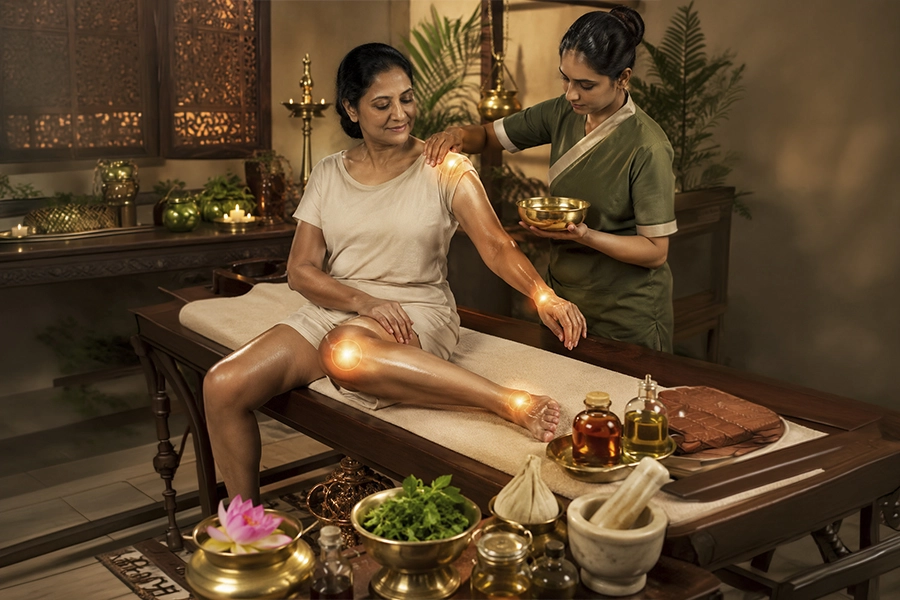
When most people hear the word "arthritis," they picture an older person rubbing a sore knee. Modern medicine recognizes arthritis as an umbrella term for more than a hundred distinct joint conditions — and interestingly, Ayurveda arrived at a similar understanding thousands of years ago, describing joint disorders through the lens of doshas rather than isolated diseases.
Sandhivata: The Ayurvedic View of Osteoarthritis
In Ayurveda, what we call osteoarthritis closely resembles a condition known as Sandhivata — a Vata-dominant disorder of the joints.
- Vata governs movement and dryness in the body; when it accumulates in the joints, it depletes lubrication and wears down tissue
- Matches the modern picture of cartilage breakdown in the knees, hips, hands, and spine
- Ayurveda links aggravated Vata to aging, cold/dry weather, irregular routines, and excessive joint strain — echoing the "wear and tear" story of osteoarthritis
Amavata: The Ayurvedic View of Rheumatoid Arthritis
Rheumatoid arthritis has a striking parallel in Amavata, a condition Ayurveda describes as the buildup of "ama" (toxic, undigested metabolic waste) combined with aggravated Vata, which then lodges in the joints.
- Ayurveda associates this with weak digestive fire (Agni), allowing toxins to accumulate and travel to the joints
- Described as affecting joints symmetrically, with stiffness that's worse in the morning — remarkably close to the modern clinical picture
- Traditionally linked to systemic imbalance rather than the joint alone, similar to how modern medicine understands it as an autoimmune, whole-body condition
Other Joint Conditions in Ayurvedic Texts
- Vatarakta — a condition combining aggravated Vata with vitiated blood, often compared to gout, known for sudden and intense joint pain
- Aamvata in children — Ayurvedic literature also acknowledges joint disorders appearing in younger people, paralleling juvenile arthritis
Why This Ancient-Modern Overlap Matters
Ayurveda's dosha-based framework and modern medicine's disease classifications arrive at surprisingly similar distinctions — dry, degenerative joint pain versus inflammatory, systemic joint disease. This overlap is part of why many people today explore Ayurvedic approaches like dietary changes, herbal formulations (such as guggulu or ashwagandha), oil therapies, and lifestyle routines (Dinacharya) alongside conventional treatment.
Bottom line: whether you look at it through Ayurveda or modern medicine, an accurate assessment of which type of joint condition you're dealing with is the first step. If you're considering Ayurvedic treatment, it's worth consulting a qualified Ayurvedic practitioner alongside your regular doctor rather than choosing one system over the other.
Consult Now